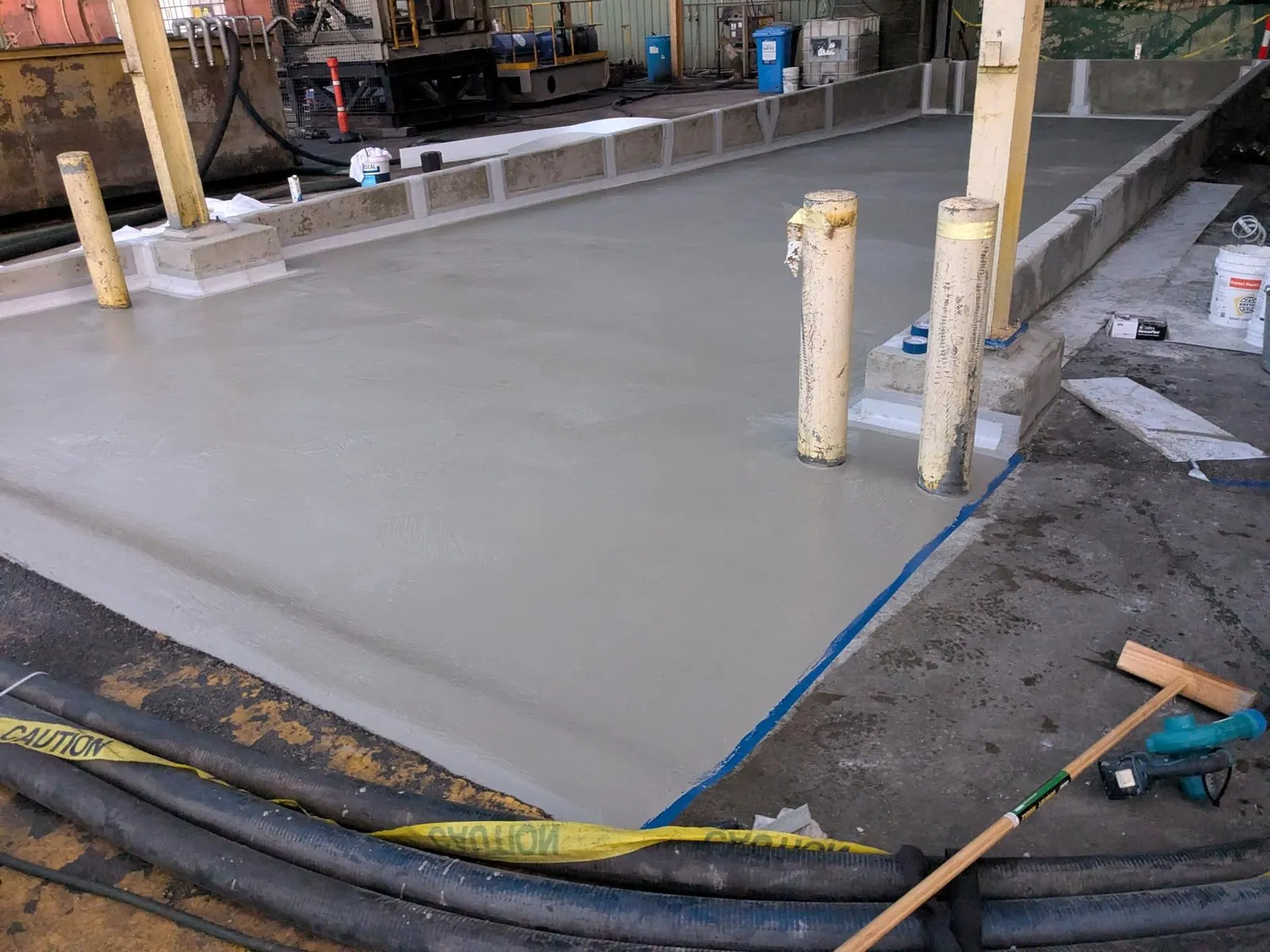
Waterproofing is the barrier that stops water passing through a building element it is not meant to pass through. In practice it is a membrane, coating, sheet or jointing system installed against the substrate and detailed at every edge, joint, penetration and drain, so that water is either kept out of the structure or, in a tank or pool, kept in.
The word covers a system, not a product. A membrane on its own does nothing until the substrate under it is sound, the falls take water to a drain, the junctions can move without tearing it, and the penetrations through it are sealed. Most waterproofing failures we investigate are not failures of the product in the tin. They are failures of one of those details.
This guide covers what waterproofing does, the main system types, where it is used, how failure shows itself and how a system should be selected.
What waterproofing means in construction
Tiles, paving, render and paint are finishes. None of them is waterproof. Grout is porous, paving joints are open, render cracks. The waterproofing is the continuous layer beneath or behind the finish, and it is the primary barrier between that prevents water from entering the structure.
The same logic applies everywhere. In a bathroom the membrane sits under the tiles. On a balcony or podium it sits over or under the screed and paving and protects the room below. On a concrete roof it sits on the slab. Against a basement or retaining wall it sits between the soil and the concrete or masonry. In a pool or tank it lines the inside.
Because the water exposure, substrate and movement differ in each of those cases, no single product suits all of them.
Why it matters
Water finds small weaknesses: a shrinkage crack, an unsealed penetration, a failed sealant joint, a membrane terminated short of a drain. It moves through those and then travels, so the damage usually appears somewhere other than the point of entry and often months later.
Left alone, that moisture does real damage: drummy and loose tiles, blown render and paint, timber decay, mould conditions in wall cavities, efflorescence on masonry, and in concrete, corrosion of the reinforcement, which is a structural problem rather than a cosmetic one. Every one of these costs more to fix than the waterproofing that would have prevented it.
Waterproof and water resistant are not the same thing
A waterproof element stops water passing through it under the conditions it was designed for. A water resistant material tolerates some exposure without deteriorating, but does not stop water going through it.
The distinction is written into the rules. AS 3740 sets out which parts of a wet area must be waterproof (the shower floor, the wall to floor junction, the floor waste connection) and which only need to be water resistant (walls outside the shower, for example). Choosing a product because the label says "water resistant" does not satisfy a requirement for waterproofing.
How a waterproofing system is installed
The sequence is similar whatever the application.
Assessment. On a new build: substrate type, drainage, movement, exposure and the finish going over the membrane. On an existing building with a leak: where the water is actually entering and how it is travelling, which is rarely where the stain is. We use high voltage electronic leak detection, flood testing and moisture mapping for this before anyone commits to a repair.
Preparation. The substrate must be sound, clean, dry to the product's limits and free of contaminants. Cracks, honeycombing, ridges and open joints are treated first. A good membrane on a bad substrate is a bad membrane.
Detailing. Corners, upstands, joints, drains, penetrations, changes of material and terminations are detailed as part of the system, with bond breakers, reinforcing, flanges and sealants that belong to it. These are the points that leak.
Membrane installation. The liquid, sheet or coating system is applied to its specified thickness, coverage and cure conditions, in the environmental conditions it allows.
Testing and protection. Where practical the membrane is tested before it is covered. It is then protected from the trades that follow, because a membrane is most often damaged after it has been installed and before it has been buried.
The main types of waterproofing

Liquid applied membranes. Polyurethane, acrylic, polyurea, cementitious and hybrid systems applied by brush, roller or spray and cured in place. They follow complex shapes and details, which is why they dominate in wet areas, balconies and detailed roof areas. Their weakness is that thickness depends entirely on the applicator, so film thickness has to be checked.
Sheet membranes. PVC, TPO, Butynol and self adhesive sheets with factory controlled thickness, welded or bonded at the laps. Common on roofs, over framed floors and where a specified thickness has to be guaranteed. The laps and terminations are where they fail.
Bituminous and torch applied systems. Modified bitumen sheets bonded with a torch or self adhesive, robust and thick, used on roofs, below ground and under protected decks. Heavier and slower than liquid systems, and not suited to exposed trafficable finishes without a wearing course.
Trafficable coatings. Polyurethane and polyurea systems for car parks, plant decks and exposed podiums where the membrane is also the wearing surface. Selected for chemical resistance, UV stability and abrasion, not just for keeping water out.
Joint and civil systems. Hydrophilic and PVC waterstops cast into construction joints, injection resins for cracks and joints in existing concrete, crystalline admixtures, and sheet or bentonite systems for below ground work. Used on basements, tanks, lift pits, bridges, tunnels and retaining structures where the water is under a head and a surface coating alone will not hold it.
Waterseal is an accredited applicator across several of these system families, which matters because the right answer for one job is usually the wrong answer for the next.
Where waterproofing is used
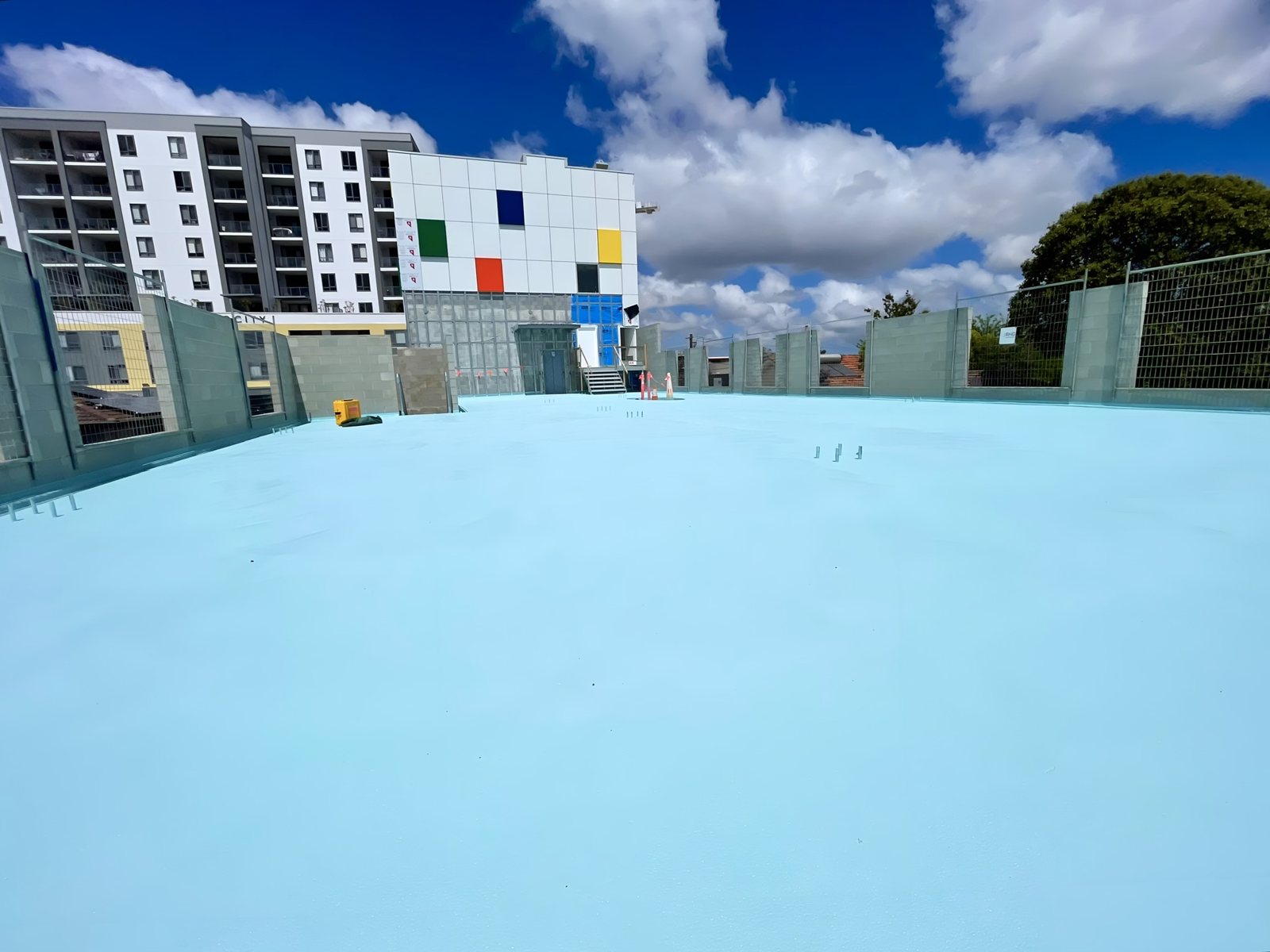
Wet areas. Showers, bathrooms, laundries and ensuites, governed by the NCC and AS 3740:2021. See wet area waterproofing. Balconies, terraces and podiums. External, exposed to rain, UV and thermal movement, usually over an occupied space, so a failure shows up in someone's ceiling. See balconies, terraces and podiums. Roofs. Concrete roof slabs crack and move; the membrane is what keeps the slab and the floor below dry. See roof waterproofing. Basements and undercrofts. Water arrives from the ground under pressure, so the system has to resist a head, not just rain. See basements and undercroft. Retaining walls. In permanent contact with damp soil; without tanking and drainage on the retained side, moisture and salts migrate through and show on the exposed face. See retaining walls. Roof gardens and planter boxes. Soil, irrigation and drainage over occupied space, with the membrane permanently wet and inaccessible. See roof gardens and planter boxes. Pools, ponds, water features and tanks. Waterproofing in reverse: the membrane keeps water in and protects the surrounding structure. See water features, ponds and pools and water retention and fire tanks. Car parks. Traffic, chemicals, weather and movement on the same surface. See car parks. Civil structures. Bridges, tunnels, underpasses, pits and tanks. See civil works. What failure looks like
It rarely starts with water dripping from a ceiling. The early signs are damp patches and staining, bubbling or peeling paint, drummy or loose tiles, efflorescence, a musty smell, mould that keeps coming back, or dampness that follows heavy rain. Below ground it is damp floors and walls, salt blooms and spalling.
None of these proves the membrane has failed. Water gets into buildings through roofs, windows, facade joints, plumbing, blocked drainage and rising ground moisture as well as through membranes, and it travels before it shows. Finding the source is worth more than treating the symptom, because a repair aimed at the wrong pathway is money spent for nothing.
Remedial waterproofing
Remedial work deals with existing buildings where the waterproofing has failed, was never done, or was never adequate for the exposure. It starts with diagnosis: where the water is entering, how it is moving and what condition the existing system and substrate are in. The repair might be localised (a drain, a penetration, a joint), a full membrane replacement, injection of a wet joint or crack, or reconstruction where the substrate itself has gone. Coating over the wet patch without that diagnosis is the most common way to pay for the same leak twice. See remedial waterproofing.
Waterproofing and structural damp
Not every damp building has a failed membrane. Structural damp comes in three forms that need to be separated before anything is treated:
Rising damp. Ground moisture drawn up through porous masonry by capillary action, typically where a damp proof course is missing, bridged or failed, leaving a tide mark and salt band low on the wall. Falling damp. Water entering from above through a roof, gutter, parapet, balcony or planter and moving down through the structure. Lateral (penetrating) damp. Water moving horizontally through a wall, most often a retaining wall or a wall below external ground level, or through an exposed facade. Each has a different fix. A surface membrane on the inside face does nothing for rising damp and can make lateral damp worse by trapping it. See structural damp.
New construction versus existing buildings
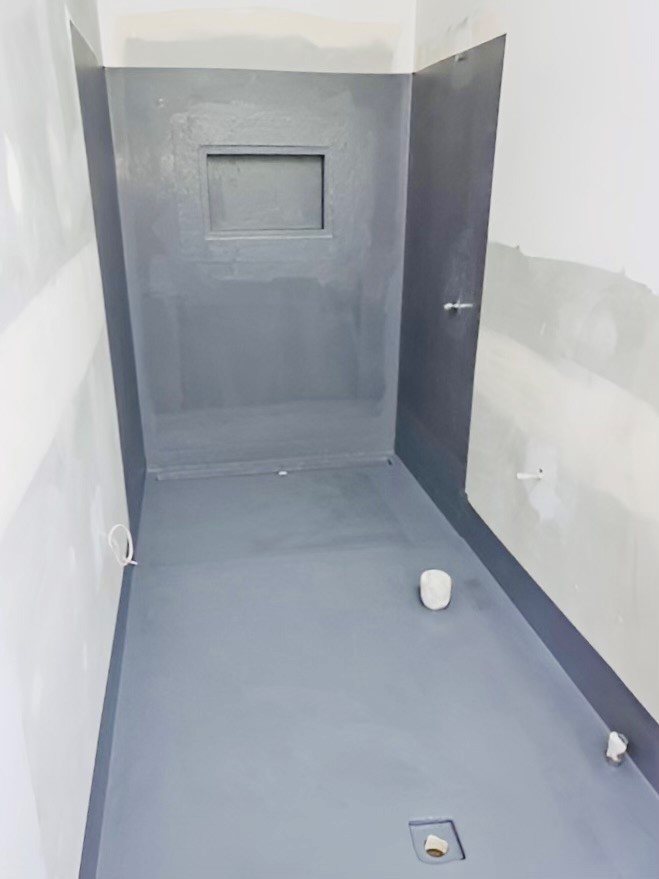
Waterproofing is easiest to get right during construction, when the substrate is exposed, the drains and penetrations can be coordinated, and the membrane can be tested before it is covered. In an existing building the first job is working out why it leaks, which may mean removing finishes, tracing moisture through concealed elements and assessing what is left of the original system. That is investigation work before it is waterproofing work, and it is why remedial jobs need both.
How the right system is selected
There is no best membrane. There is a best system for the job, and it is chosen on:
Location: internal, external, above or below ground Exposure: splashing, rain, ponding, retained water, ground water under a head Substrate: concrete, masonry, render, sheeting, timber, existing membrane Movement: thermal, structural, vibration, and where the joints are Finish: tiles, screed and paving, soil, a trafficable coating, or nothing Drainage: where the water goes once it reaches the membrane Details: how many penetrations, joints and terminations there are and how hard they are to access Condition: new work or remedial System selection comes before product selection. The product is the last decision, not the first.
What waterproofing costs and how long it lasts
Costs range widely because the work does. A single shower recess and a commercial podium are not the same job, and what drives the price is area, substrate condition, the system required, access, the amount of preparation and detailing, whether existing finishes have to come off, and whether the substrate has been damaged. For an existing leak, the diagnosis is usually the cheapest part of the job and the part most often skipped.
Lifespan depends on the same things: system type, preparation, workmanship, exposure, movement, drainage, and whether the membrane was protected once installed. A properly selected and installed system in a protected location will outlast the finish over it. A good product on a poor substrate with poor detailing will not.
Testing existing waterproofing
Yes, it can be tested. On non conductive membranes over a conductive substrate, high voltage electronic leak detection pinpoints breaches without opening up the finish. Flood testing proves a contained area. Moisture mapping with capacitance and microwave instruments traces where water is travelling once it is in. Between them they usually locate the pathway without demolishing large areas to look for it.
Choosing a waterproofing contractor
Membrane application is the easy part. What separates contractors is preparation, system knowledge, detailing, film thickness control and the ability to diagnose an existing leak rather than coat over it. Look for experience in the specific type of work, accreditation with the membrane systems being used, an understanding of the NCC and Australian Standards that apply, and a body of comparable completed work.
Waterseal has provided waterproofing across Western Australia since 1996 for domestic, strata, commercial and civil clients. See completed projects or contact Waterseal.
Frequently asked questions
What is waterproofing in simple terms? A barrier that stops water going where it should not: out of the ground into a basement, out of a bathroom into the wall, or out of a pool into the structure around it.
What is a waterproofing membrane? The continuous layer that provides that barrier. It can be a liquid that cures on the surface, a factory made sheet, a bitumen sheet or a coating, depending on the application.
Is waterproofing the same as sealing? No. Sealant closes individual gaps and joints. Waterproofing is the system that protects the whole element. Sealant is part of it, not a substitute for it.
Is waterproofing the same as damp proofing? No. Damp proofing resists moisture vapour and capillary movement, a damp proof course being the usual example. Waterproofing resists liquid water, including water under pressure.
Can you waterproof over existing tiles? Products exist, but they are not a fix for a failed undertile membrane and should not be applied until the source of the leak is known.
What causes waterproofing to fail? Poor preparation, the wrong system for the exposure, thin application, missed or poor detailing at junctions and penetrations, damage after installation, blocked or inadequate drainage, and movement the system was not designed for.
Can waterproofing stop rising damp? Not on its own. Rising damp is a damp proof course problem and needs the moisture path cut, usually by a chemical or physical damp proof course, with salt contaminated render replaced. A membrane on the wall surface will hold the moisture in the wall.