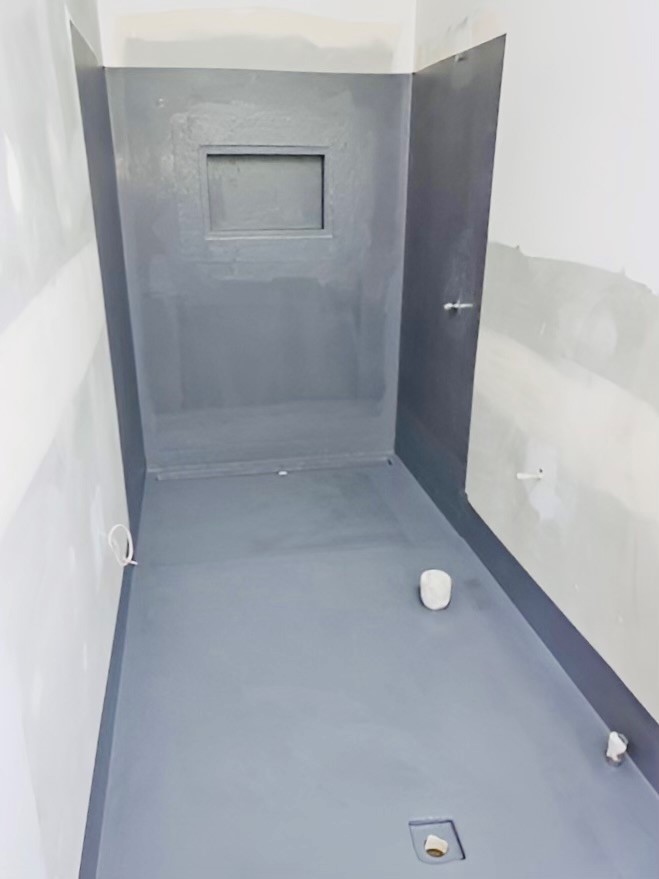
Water leaks in commercial buildings can be difficult to trace. Water may enter through a damaged waterproofing membrane, travel along a structural joint or slab, and become visible some distance from the original defect.
For commercial property owners, builders and facilities managers in Perth, identifying the source of water ingress is essential before planning repairs.
Two approaches that may be considered during a waterproofing investigation are electronic membrane testing and waterproofing flood testing. Both can provide useful information, but they operate differently and serve different purposes.
Understanding when each method is appropriate can help avoid unnecessary investigation work and support better waterproofing repair decisions.

What Is Electronic Membrane Integrity Testing?
Electronic membrane integrity testing uses electrical principles to identify possible breaches or discontinuities in compatible waterproofing membranes.
High-voltage electronic leak detection (HVELD) requires a dry, exposed, compatible membrane and a suitable earth point. Waterseal checks the membrane, substrate, access and electrical test path before choosing the method.
During an assessment, the technician reviews the membrane material, substrate, surface condition and accessibility before selecting an appropriate method. Where testing identifies a suspected breach, its location may be marked for closer inspection and repair planning.
Electronic testing can be especially useful for investigating membrane defects on suitable commercial roofs, podiums, terraces and waterproofed decks.
However, not every membrane is compatible with electronic testing. Conductive materials, inaccessible surfaces, protective layers and unsuitable electrical conditions can limit the method’s effectiveness.
The suitability of a test must therefore be established before relying on its findings.
What Is Waterproofing Flood Testing?
Controlled water testing can take two forms. Ponding holds water over a suitable horizontal area that can safely contain it. Where ponding is unsuitable, controlled hose testing applies water to selected vertical faces, upstands or interfaces in stages while the team monitors for leakage.
The area is monitored for evidence of water loss or moisture appearing in adjacent or underlying building elements.
The method and monitoring period are chosen to suit the area and the suspected water path.
However, it does not necessarily identify the precise location of a membrane defect.
Water can travel beneath surface finishes, through construction joints or along concealed pathways before becoming visible.
Flood testing also requires careful consideration of drainage, water containment, structural loading, access and the risk of introducing moisture into occupied areas.
For this reason, flood testing should only be considered after the construction and site conditions have been assessed.
Electronic Membrane Testing vs Flood Testing: Key Differences
Although both methods are used in waterproofing investigations, they answer different questions.
| Comparison | Electronic membrane testing | Controlled water testing |
|---|---|---|
| Main purpose | Locates potential breaches in compatible membranes | Assesses leakage under controlled water exposure |
| Method | High-voltage electrical testing where suitable | Ponding on suitable horizontal areas or controlled hose testing |
| Defect location | May identify a specific breach | May reveal leakage without pinpointing the entry point |
| Requirements | Dry, exposed, compatible membrane and suitable earth point | Safe containment and loading for ponding; controlled application and drainage for hose testing |
| Limitations | Depends on membrane and construction | Water can travel before becoming visible |
Neither approach should be treated as a universal solution.
A successful investigation starts by identifying what needs to be established: whether a membrane has a particular defect, whether an area is allowing water through, or how moisture is moving within the building.
When Is Electronic Membrane Testing Useful?
Electronic testing may be suitable where a commercial building has a suspected defect in an accessible, compatible waterproofing membrane.
Commercial Roofs and Roof Decks
Roofs contain penetrations, drainage outlets, terminations and junctions where waterproofing defects may occur.
Where the membrane and site conditions allow, electronic testing can help narrow down possible breach locations before repairs are planned.
Podiums and Terraces
Podiums and terraces often include multiple construction layers, drainage interfaces and occupied spaces beneath them.
Testing suitability depends on the waterproofing assembly, the accessibility of the membrane and the potential routes of water ingress.
Balconies and External Decks
Water entering around door thresholds, movement joints or penetrations may travel beneath finishes before becoming visible.
Electronic integrity testing may help identify certain membrane defects, although surrounding construction details may require separate investigation.
Remedial Waterproofing Projects
Where a membrane type is known and suitable access exists, targeted testing may support defect investigations, repair planning or post-repair assessment.
The test findings should always be considered alongside the building’s construction and the recorded limitations.
When Might Flood Testing Be Considered?
Controlled water testing can help establish whether an area leaks under a defined exposure. The construction, likely water path and site risks determine whether ponding or hose testing is appropriate.
It may be considered during certain waterproofing installation assessments or investigations into persistent water ingress.
Before proceeding, several factors need to be reviewed.
Structural capacity: Retained water introduces additional loading, which must be evaluated for the structure.
Containment and drainage: Check that test water can be applied, collected and drained safely.
Occupied areas: Water exposure must not create unacceptable risks to tenants, equipment, finishes or adjoining spaces.
Waterproofing construction: The membrane, junctions, penetrations and surrounding assembly must be suitable for the proposed testing approach.
Even where a flood test reveals leakage, additional investigation may be required to locate the entry point and determine the appropriate repair.
Where Do Moisture Mapping and Thermal Imaging Fit?
Electronic membrane testing and flood testing are not the only tools used in commercial leak diagnostics.
Moisture mapping helps assess the distribution and possible movement of moisture through building materials. It can identify areas requiring closer investigation without necessarily establishing the precise point where water entered.
Thermal imaging identifies temperature patterns that may indicate areas of concern. These observations generally require additional checks before conclusions about moisture or membrane failure can be drawn.
Waterseal also explains moisture mapping in Diagnostic Value of the HF Sensor MOIST 350B.
These techniques provide different types of information. Combining relevant observations can help develop a more reliable explanation of water ingress than relying on one instrument or test result.
How Should Commercial Property Managers Choose a Testing Method?
The right investigation begins with the building problem rather than the testing equipment.
A property manager dealing with recurring roof leakage should consider where the damage appears, when it occurs and whether previous repairs have been attempted.
Construction drawings, membrane specifications, maintenance records and photographs can help clarify the investigation requirements.
The assessment should also consider building access, occupied areas, drainage details, nearby penetrations and any known structural concerns.
Where the membrane system is unknown or concealed, an initial inspection may be necessary before selecting a testing method.
Waterseal’s Commercial Leak Diagnostics Perth service takes an evidence-led approach to investigating water ingress, using methods selected around the membrane, construction and suspected moisture pathways.
What Should a Waterproofing Investigation Report Include?
Testing is most useful when the findings can support an informed repair decision.
Depending on the agreed scope, the report documents the area tested, the method, site conditions and any limitations. Waterseal’s HVELD test certificates record the test voltage, earth point, membrane product and thickness, and ambient conditions.
It may also include photographs, marked defect locations, moisture observations, suspected water-entry pathways and recommended next steps.
Clear reporting helps building owners and contractors understand whether further investigation is required or whether a targeted remedial waterproofing scope can be developed.
A report should explain what the evidence supports without presenting a limited test as proof that every concealed defect has been identified.
Frequently Asked Questions
Can electronic membrane testing replace flood testing?
Not in every situation. The methods assess different aspects of waterproofing performance, and suitability depends on the membrane, construction and investigation objective.
Does flood testing identify the exact location of a leak?
Not necessarily. Water may travel through concealed building elements before becoming visible. Additional diagnostic work may be required to establish the likely entry point.
Can electronic testing be performed on every waterproofing membrane?
No. HVELD needs a dry, exposed, compatible membrane and a suitable earth point. Other electronic methods have their own requirements.
Can moisture mapping identify a membrane puncture?
Moisture mapping can help show where water is present or moving within materials. It does not directly identify every membrane defect, so other tests or inspections may be necessary.
Does a successful test guarantee a waterproofing system will never leak?
No. Testing provides information about the areas, conditions and methods assessed. It cannot guarantee the future performance of every membrane junction, penetration or concealed construction detail.
Discuss Commercial Leak Diagnostics With Waterseal
Recurring leaks in commercial roofs, podiums, balconies and other waterproofed structures require more than identifying the visible signs of moisture.
The appropriate investigation should consider the waterproofing system, suspected water pathways, site conditions and the information needed to plan effective repairs.
Waterseal provides commercial leak diagnostics in Perth, helping building owners, contractors and property managers better understand water-ingress problems and determine suitable next steps.
If your building is experiencing recurring water ingress, share the available photographs, building information and previous repair history with Waterseal to discuss an appropriate investigation.